Lock Gate Replacement Without Cranes

Barnhart’s Key to fit any Lock

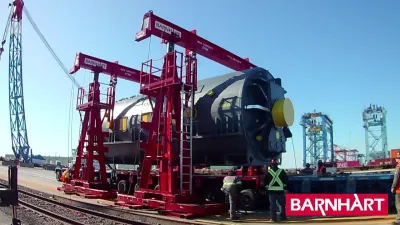
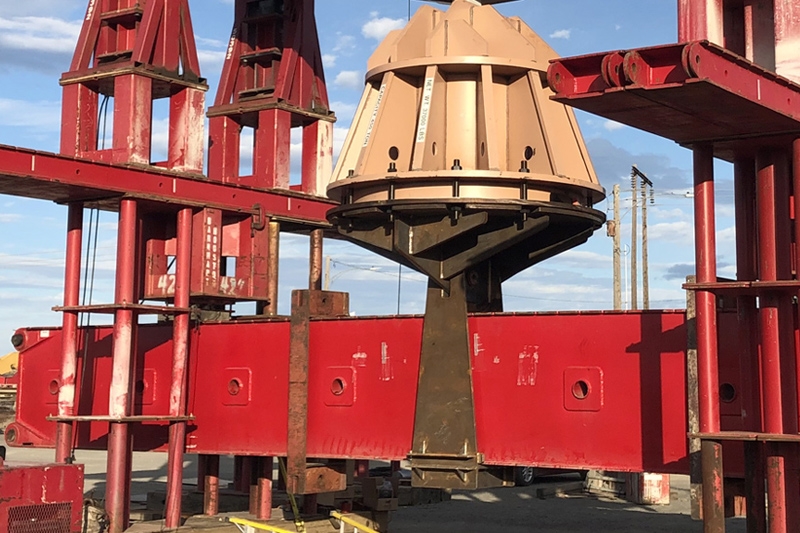
The US Army Corps of Engineers has recently undertaken a plan to replace the gates on several locks in the Mobile District. Each of the locks under consideration has roughly the same dimensions with varying gate styles. In this case, the gates in questions were 85’ tall, 65’ wide and 7’ thick, weighing in at 360 Tons each. The key to the Barnhart solution was the 500 Ton containerized hoist that travel across the lock on a wheeled trolley. The trolley was motivated by a gripper system inspired by our friends at Elgood Mayo. The major structural components consisted of two 8’ deep, 150’ box girders that were placed atop runways on either side of the Lock, which also allowed for access to all of the hydraulic components that are integral to the operation of the gates themselves. In the end, the new system resembled a massive version of a bridge crane which enabled the gates to be handled in both the recessed and mitered positions.

The new gates arrived via barge and were the first gates ever to be completely assembled before arriving on site. Barnhart’s system allowed for the existing gates to be removed in one piece, and to be tailed and lowered onto a barge. The new gates were then immediately received for installation. The installation process had two steps. The first involved attaching a temporary securement system that allowed the gates to be “tied” back to the Lock wall while the lock was still filled from the lower pool. These securements remained in place until the Lock was dewatered. Following the dewatering process, the new gates were lifted and set upon their new bases giving the Corps’ subcontractors the ability to work “in the dry.” Past replacement procedures required gates to be lifted using barge mounted cranes and work to be carried out using divers and submersible equipment. The Barnhart method provided a way to carry out the work in a safer manner with standard equipment and personnel working on dry foundations. Barnhart’s solution provided a higher degree of safety and a more suitable plan for execution. It’s what we do.